FAQs: More about the Special Rate Variation
What is a Special Rate Variation (SRV)?
An SRV is a request made by Council to increase rates by more than the usual amount allowed by the NSW Independent Pricing and Regulatory Tribunal (IPART). Each year, IPART sets a limit on how much rates can be raised, known as the rate peg.
NSW councils can apply to IPART for an SRV to the rate peg which will be considered against the guidelines set by the NSW Office of Local Government. SRVs can only happen if Council applies to the IPART for approval to increase its rates.
Council must meet all the criteria required by IPART before a rate increase can be approved and supply detailed financial information, on how it plans to manage expenditure and contain costs and provide details about why it needs a special variation to rates.
What is the Rate Peg?
The rate peg is a regulatory mechanism set each year by IPART that determines how much councils can increase general rates to keep up with standard cost pressures, such as inflation and the rising costs of delivering essential services.
However, the rate peg does not always cover the true cost increases that councils face. In addition, many services that were once the responsibility of the NSW Government have shifted to local councils over the years, which also adds to Council's operational responsibilities and costs without equivalent increases in funding.
In our case, the rate peg alone is not sufficient to maintain our current services at their existing level. As a result, Council is applying for an increase above the rate peg to address the budget shortfall.
What if I can’t afford the rate increase?
We’ve recently reviewed our Financial Hardship Policy to ensure it provides meaningful support for residents who may be finding it difficult to pay their rates, fees or other Council charges, including any potential increase to rates. We understand that everyone’s situation is different, and the policy is designed to offer flexible payment arrangements that can be tailored to individual circumstances, including support for those on fixed incomes. If you’re experiencing financial pressure, we encourage you to reach out to our team to discuss the best solution for your circumstances.
What’s the alternative to an SRV?
If Council does not proceed with an SRV, significant cuts to services and the capital works program will be necessary. Rate revenue would be limited to the annual rate peg, which does not keep up with the costs of delivering Council's services. This would result in growing operating deficits, which is outlined in Council’s adopted Long Term Financial Plan.
Over time, the quality of local infrastructure, including roads, footpaths, and community facilities will deteriorate, and service levels will decline. Without a sustainable financial path forward, the Uralla Shire may no longer be able to function independently and could risk amalgamation.
What support is available for pensioners?
We understand that any change to rates can raise concerns, particularly for residents on fixed incomes. If you hold a valid pensioner concession card, you may be eligible for a rebate of up to $250 on your rates.
If you're unsure whether you qualify or would like more information, please contact our friendly Customer Service team on 6778 6300.
What is cost shifting and how does it affect our Council?
Cost shifting refers to the practice where State and Federal governments redistribute infrastructure, services, or regulatory functions to local councils to deliver but provide little to no funding to support these mandates. According to the LGNSW commissioned Cost Shifting 2025: How State Costs Eat Council Rates report NSW councils are now shouldering around $1.5 billion in externally imposed costs each year, accumulating to over $11.3 billion in the past decade
The burden is particularly heavy for rural councils like Uralla Shire. Independent analysis shows that large rural councils face a per-ratepayer cost of approximately $550-$571 per rate payer, which is well above state average.
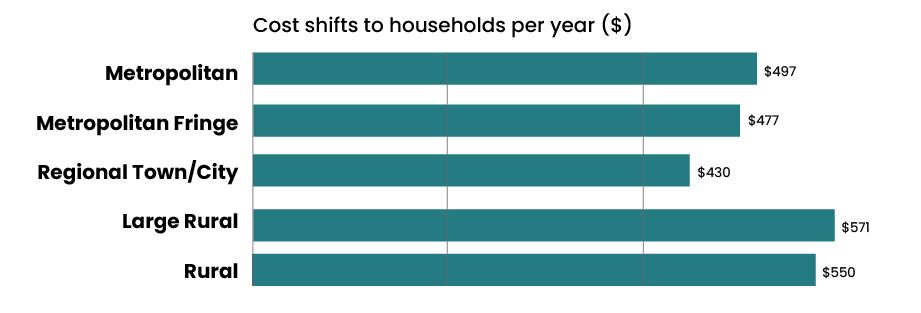
Data source: LGNSW Cost Shifting Report 2025.
These financial pressures stem from several significant cost-shifted responsibilities, including rate exemptions for state-owned and non-profit landholders, state waste levies, under costed development assessments, emergency services levies, and reduced funding for public libraries. Such mandates force councils to reallocate already limited rate revenue to manage obligations that were not part of their original budgets.
For our Council, this financial pinch is a major driver behind the consideration of an SRV which is aimed at sustainably bridging funding gaps and preserving local service levels amidst ongoing cost shifts.
How would the SRV be applied to my rates?
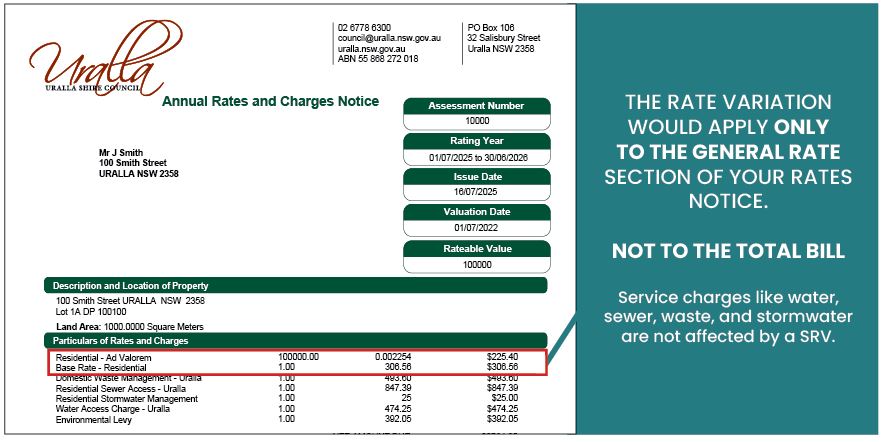
The SRV would only apply to the General Rate component of your rates notice. It would not impact service charges like water, sewer, waste, or stormwater drainage.
See below example rates notice: